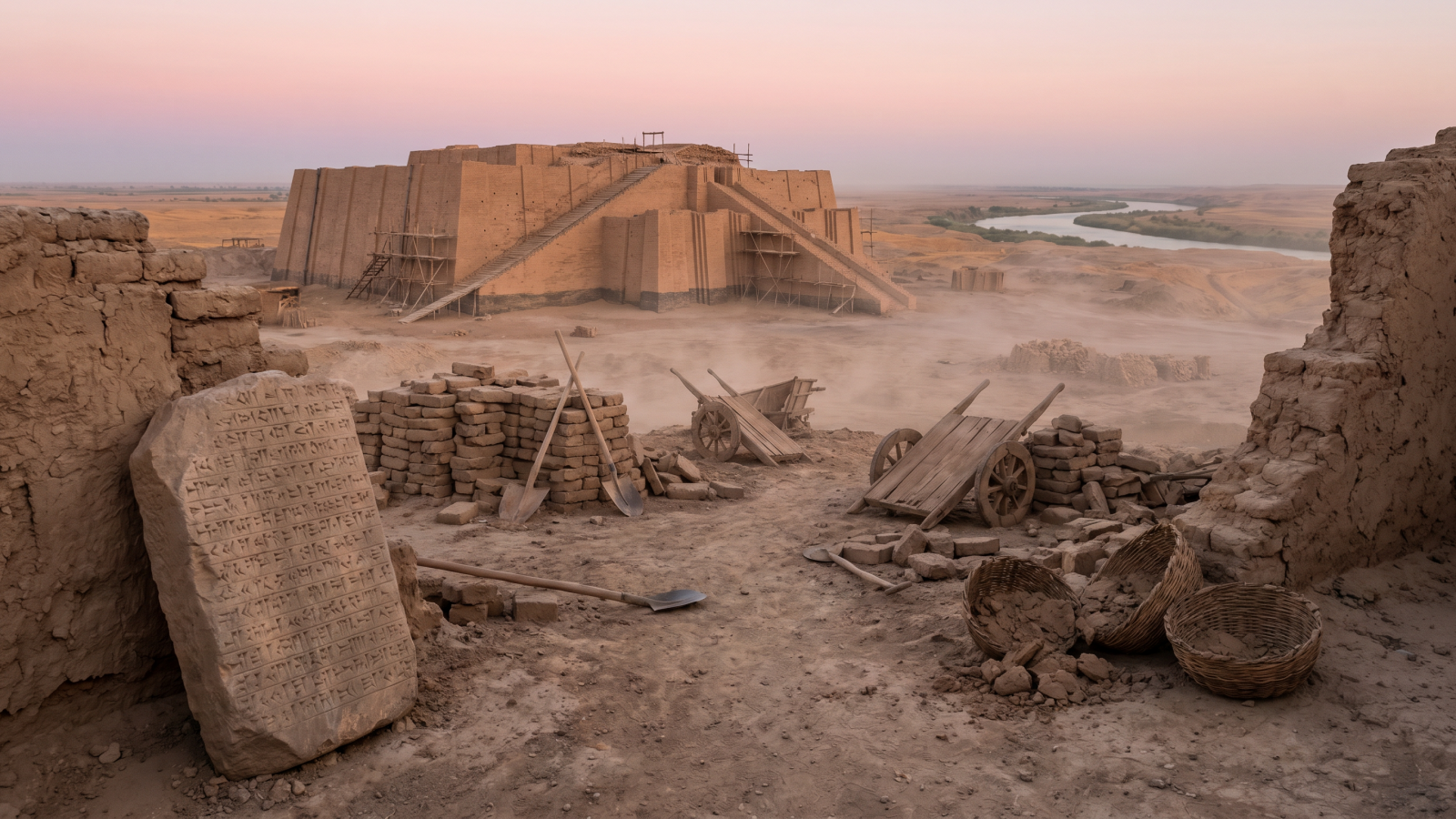

Before humans existed, someone had to do the work of the gods. According to one of the oldest written stories on Earth, that work fell to a group of lesser deities called the Igigi — and what they did about it changed the history of every religion that came afterward.
The Igigi are barely a footnote in most discussions of Sumerian and Babylonian mythology. They appear briefly in the Atrahasis Epic, surface again in the Enuma Elish, and then mostly vanish from the tradition that built on them. But the story they are at the centre of — a labour strike by underclass gods that ends with the creation of human beings — is arguably the single most consequential mythological event in the ancient Near East. And once you read it without the filter that mainstream academia has tried to layer over it for the past century, the story stops sounding like myth and starts sounding like history.
If you have read about the Anunnaki, you have already encountered half the story. The Igigi are the other half. And once you understand who they were, several puzzles in Sumerian, biblical and apocryphal literature start to look like the same puzzle.
Who Were the Igigi?
The Igigi were a class of Mesopotamian deities ranked below the Anunnaki in the cosmic hierarchy. The Anunnaki were the great gods — An (the sky), Enlil (the air), Enki (the deep waters), and their family. The Igigi were everyone else. Roughly six hundred of them, according to the texts. The work-class of heaven.
The word “Igigi” itself is uncertain in origin. Some Assyriologists translate it as “the watchful ones.” That translation alone is worth pausing on: the Igigi are described, in the oldest written tradition on Earth, by exactly the same word that the Book of Enoch — written more than a thousand years later — uses to name the Watchers who descended from heaven and rebelled. By the time the Babylonians inherited the Sumerian tradition, “Igigi” was used as a catch-all term for the lesser sky gods, distinct from the higher Anunnaki and from the underworld deities called the Anunna.
What they did was labour. Specifically, the kind of labour that gods of higher rank refused to do — physical, exhausting, endless work that had to be performed somewhere. According to the Atrahasis Epic, that somewhere was Earth, and the work was digging.
The 40-Year Job That Broke Them
The Atrahasis Epic, composed in Akkadian around 1700 BCE, opens with a striking premise. The Anunnaki — the senior gods — had decided that the world needed irrigation. Rivers would have to be dug. Canals would have to be carved. Watercourses would have to be carved into the soil of southern Mesopotamia to make it habitable.
The Anunnaki were not going to do this work themselves. They assigned it to the Igigi.
For forty years — some translations say a hundred years, others a thousand — the Igigi dug. They cut the bed of the Tigris. They cut the bed of the Euphrates. They moved the earth that became the agricultural heart of Sumer. And the longer they worked, the more bitterly they understood what the arrangement actually was. Six hundred gods in a ditch, while a much smaller number of senior deities watched from above.
The Atrahasis text describes the breaking point in remarkably modern terms. “Excessive toil has killed us, our work was heavy, the distress much.” A list of grievances was drafted. A leader was chosen. And then one night, the Igigi burned their tools.
The First Labour Strike in Recorded History
What happened next is preserved in some of the oldest surviving lines of literature on Earth. The Igigi marched in mass on the house of Enlil, the chief of the Anunnaki. They surrounded his temple at the city of Nippur. They demanded an end to the work.
Enlil was furious. He called the council of senior gods. He demanded retribution. He wanted to know who had organised the rebellion and who would be punished.
Enki — Enlil’s brother, the god of wisdom and the deep waters — talked him down. The Igigi were not the enemy. Their grievance was real. The work had to be done, but the workers did not have to be gods. There was, Enki argued, a better solution. He would build a slave race.
The Creation of Humanity
Enki’s solution was to create a new race of beings — capable of work, capable of memory, capable of obedience — that would inherit the labour of the Igigi. He needed two ingredients. Clay from the riverbeds the Igigi had been digging. And the blood of a god.
The Anunnaki selected one of the Igigi — a deity named We-ila in the Atrahasis text, sometimes rendered Geshtu or Aw-ilu in other tablets — to be sacrificed. His flesh and blood were mixed with clay. Enki and the mother goddess Ninhursag shaped the mixture into seven men and seven women. The first humans took the breath of life and stood up.
From that moment, the Atrahasis Epic asserts, the work of the Igigi belonged to humans. We dug the canals. We farmed the soil. We built the cities. The gods went back to heaven and watched.
This is, almost word for word, the same story Genesis tells about Adam — that humans were formed from clay, given the breath of life, and tasked with cultivating the earth. The Sumerian version is older than Genesis by approximately fifteen hundred years. The implications of that are exactly the implications that the institutional gatekeepers of biblical scholarship have spent two centuries trying to manage.
Igigi vs Anunnaki — What’s the Actual Difference?
The two groups are often conflated in modern paranormal writing, which has muddied a distinction the Sumerians themselves took seriously.
The Anunnaki are the named, individually-known senior gods — An, Enlil, Enki, Ninhursag, Inanna, Marduk, Nergal, and roughly a dozen others depending on which city-state’s tradition you follow. They have personalities. They have temples. They have epics named after them. They were the ruling class of the Mesopotamian pantheon.
The Igigi are largely anonymous. Six hundred of them existed, according to the texts, but only a handful are named individually. They are the proletariat of heaven — defined by their function, their labour, and their eventual rebellion. They were not lesser in power, necessarily, but lesser in status and in voice.
In modern ancient astronaut interpretations of these texts, the Anunnaki are recast as a senior class of visiting extraterrestrials and the Igigi as the rank-and-file. The clay-and-blood human-creation story becomes, in this reading, an unambiguous description of genetic engineering. The Sumerians did not have the vocabulary of biotechnology. What they had was the most accurate metaphor available to a Bronze Age scribe: a senior being took raw biological material from the local soil, added DNA from a sacrificed member of an existing intelligent species, mixed the two, and produced a new being capable of work. That description is more than 3,700 years old. It is also, almost exactly, the description of a modern bioengineering protocol.
The Igigi in Ancient Astronaut Theory
The clearest popularizer of the alien-Igigi reading was Zecharia Sitchin, the Russian-Azerbaijani author whose 1976 book The 12th Planet argued that the Anunnaki were a species of advanced beings from a planet called Nibiru. In Sitchin’s interpretation, the Igigi were the working-caste of that civilisation — engineers, miners, and labourers sent to Earth to extract resources, primarily gold needed to repair the atmosphere of their home world.
Sitchin’s reading has been attacked relentlessly by professional Assyriologists since the day it was published. The attacks tend to follow a predictable structure — his translations are not the institutional consensus, his etymology is more flexible than the academic mainstream allows, his Nibiru orbital mechanics is not the model NASA endorses. What the attacks rarely address is why Sitchin’s reading fits the actual text so cleanly. The Atrahasis describes a senior class of beings assigning physical labour to a junior class. It describes that junior class digging on Earth specifically. It describes the moment the junior class refused to dig any more. And it describes the senior class engineering a biological replacement workforce.
If the text is a metaphorical creation myth, then Sitchin has overinterpreted it. If the text is a literal historical record, then the mainstream Assyriological reading has been systematically underinterpreting it for a century. Both possibilities remain open. The institutional academy will continue to insist only the first is serious. Anyone who has actually sat with the Atrahasis tablets in translation knows the second possibility is not as easily dismissed as the textbooks would like.
The version of the Igigi story that circulates in Anunnaki-disclosure communities typically goes further than Sitchin. The Igigi rebelled. The Anunnaki created humans as biological labour. We are, in this reading, descendants of a deliberate genetic project — and the “image of God” that humans are said to be made in is, in fact, the image of the species that engineered us.
Are the Igigi the Same as the Watchers in the Book of Enoch?
This is the overlap that becomes harder to dismiss the longer you look at it.
The Book of Enoch — a Jewish apocryphal text composed between the third century BCE and the first century CE — describes a class of beings called the Watchers, who descended from heaven, took human wives, and taught humanity forbidden knowledge. The Watchers number two hundred in some accounts. They are explicitly described as a lower order than the most senior angels. They were assigned to observe humanity. They rebelled.
The parallels with the Igigi are striking. Both are large groups of lesser celestial beings. Both are assigned to a job involving Earth. Both rebel against the higher order. Both rebellions end with consequences for humanity. The name “Igigi” itself is translated by some Assyriologists as “the watchful ones” — which is essentially the literal meaning of the Hebrew word that became “Watchers” in Enoch.
Both traditions emerged from the same broader Mesopotamian-Jewish cultural matrix, and they were almost certainly drawing on overlapping older sources — sources that the Sumerians did not invent and that the Jewish apocryphal authors did not invent either. Whether the Watchers and the Igigi are literally the same beings, recorded under different names in different millennia, is a question that mainstream comparative religion can dismiss as coincidence — but cannot disprove.
Why the Igigi Disappear From Later Tradition
Once humans existed, the Igigi had served their narrative purpose. They appear briefly in later Babylonian creation texts — usually as a generic backdrop, the “host of heaven” against which the senior gods are described. Individual Igigi are rarely named. Their temples are not preserved. Their rebellion is not commemorated.
That is, in some sense, the most poignant detail of the whole tradition. The gods who broke against forty years of digging — who organised the first recorded labour action in human literature, who forced the senior pantheon to invent humanity rather than let the strike continue — were almost completely forgotten by the religions that grew out of theirs. The Anunnaki retained their personalities. The Igigi became a noun. A class. A category. A footnote.
The pattern is familiar to anyone who has watched modern history. The working class that builds the foundations of a civilisation is rarely the class whose names get carved into its temples.
Frequently Asked Questions
How do you pronounce “Igigi”?
Most Assyriologists pronounce it ee-GEE-gee, with a hard “g” in both syllables and the stress on the middle. Some scholars use ih-gee-gee. The original Sumerian and Akkadian pronunciations are reconstructions and not certain.
Are the Igigi mentioned in the Bible?
Not by name. However, every major element of the Igigi narrative — the creation of humans from clay mixed with divine essence, the assignment of agricultural labour to humans, and a class of lesser celestial beings who rebel against the senior divine order — appears in Genesis and, more explicitly, in the Book of Enoch. The relationship between these texts and the Sumerian originals is one of the most quietly contested questions in biblical scholarship.
Were the Igigi physical beings or spirits?
In the texts, they are unambiguously described as physical — they dig, they burn their tools, they march, they bleed when one of them is sacrificed. The Sumerians did not draw the sharp line between divine and physical that later monotheistic religions would. Whether you read them as literal physical entities, as personifications of natural forces, or as a Bronze Age memory of a flesh-and-blood non-human visiting class depends largely on which tradition you are reading the texts within.
Did the Igigi create humans?
No. The creation of humans was carried out by the Anunnaki — specifically Enki and Ninhursag — using clay and the blood of a sacrificed Igigi. The Igigi caused the creation by rebelling, but they did not design it. One of them was the raw biological material. In modern terms: one Igigi provided the DNA, and the Anunnaki engineered the species.
How many Igigi were there?
The most commonly cited number is six hundred, drawn from the Atrahasis Epic. Some other Mesopotamian texts give different numbers ranging from three hundred to several thousand. There is no consistent count across the tradition.
Are the Igigi mentioned in the Quran?
No. The Quran’s cosmology does not include the Mesopotamian pantheon. However, the Quran does describe two angels called Harut and Marut who were sent to Earth and rebelled — a narrative motif that shares structural similarities with both the Watchers and the Igigi, and likely descends from the same broader Near Eastern tradition.
Further Reading
If the Igigi narrative interests you, the most rigorous accessible translation is Stephanie Dalley’s Myths from Mesopotamia: Creation, the Flood, Gilgamesh, and Others (Oxford World’s Classics). Benjamin Foster’s Before the Muses includes a more literal scholarly translation of Atrahasis and the related texts.
For the broader question of how Sumerian deity-narratives map onto modern paranormal and biblical frameworks, see our pieces on the eight pre-flood kings who allegedly ruled Earth for 241,000 years and the case for whether ancient texts describe genetic engineering.
Discover more from Infinity Explorers
Subscribe to get the latest posts sent to your email.
What was the name of the igigi who lead the revolt
please